neurogenesis-sim
Grow spiking neural networks the way nervous systems are built — by hand, by genes, or both — and simulate them cheaply.
neurogenesis-sim is a general toolbox for building circuits through development. You describe where tissue is (2D or 3D shapes) and what is already known about it (layers, areas, maps, cell positions). You then choose a sequence of developmental stages (cell division, migration, differentiation, axon growth, pruning, activity-dependent refinement …). For every parameter of every stage you decide whether it is set by hand, read from a hand-drawn field, controlled by genes (and then evolved), or fitted to data. The result is a spiking network that can be simulated, measured, evolved and shared as a module.
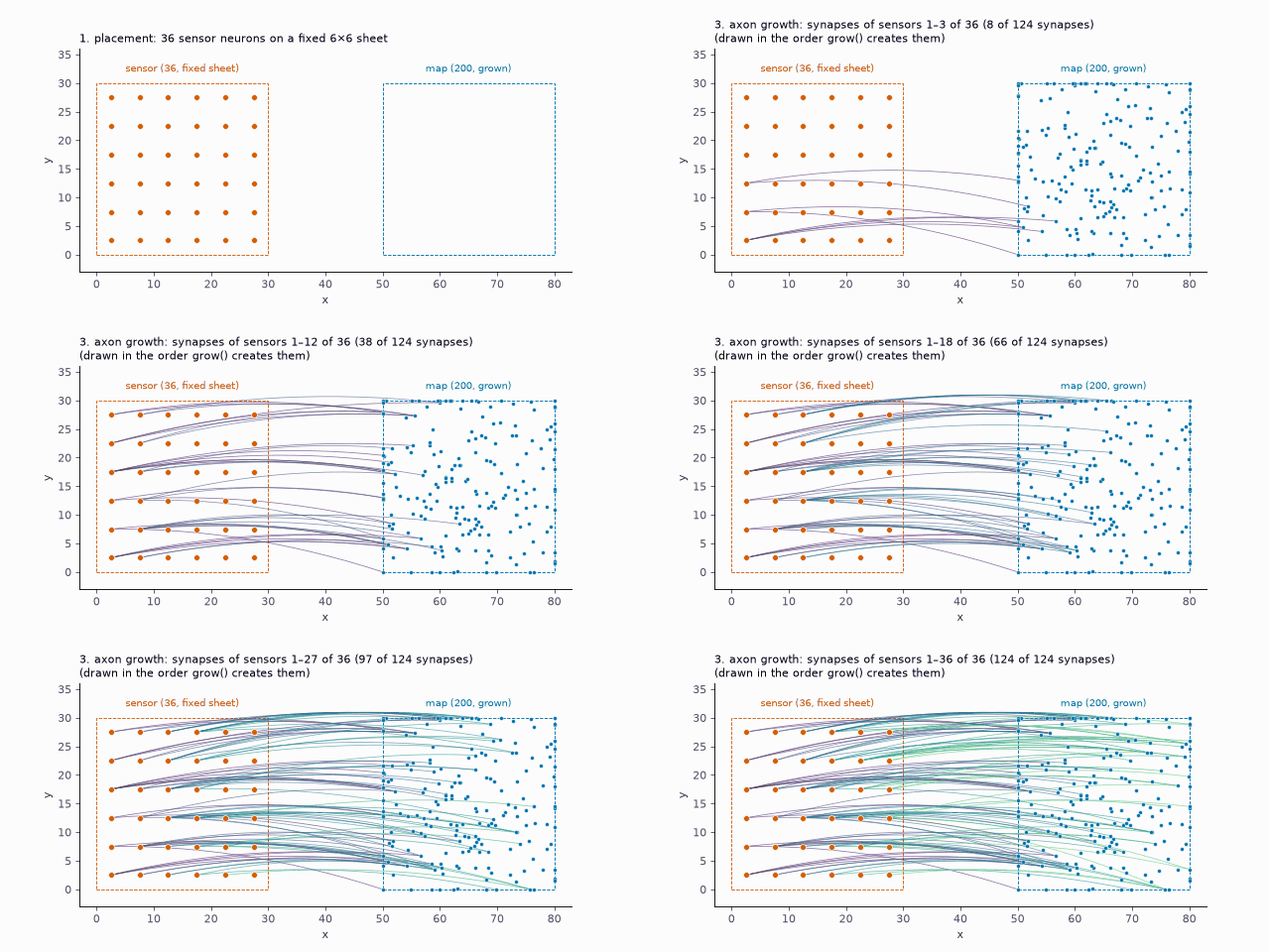
A sensor sheet → map circuit grown from a genome (see Topographic projection grown from genes).
Workflow |
What you specify |
What development does |
|---|---|---|
Supervised (by hand) |
geometry, cells, connections or connection rules |
compiles and simulates exactly what you specified |
Unsupervised (genetic) |
a genome and a schedule of stages |
genes control every stage; evolution searches genomes that work for every developmental seed |
Semi-supervised |
a hand-made scaffold (layers, maps, landmarks) plus a schedule |
genes and fitted parameters work on top of the scaffold |
For AI assistants
The whole documentation is also published as one Markdown file, with a generated status section (what exists, what
is not done yet, open pull requests), to paste or upload into a chat with an AI assistant:
neurogenesis-sim-context.md (about 70k
tokens), or the short neurogenesis-sim-brief.md
(about 11k tokens). Both are rebuilt with the site; python scripts/build_context.py makes them locally.
Highlights
One integer spiking kernel, four implementations with identical spikes: Python reference, JAX (CPU / GPU), the browser (TypeScript) and a portable C library (
nglif) used by the desktop apps.Switchable neuron models on the same grown network: integer LIF, two-compartment, Hodgkin–Huxley.
Know the cost before you run: memory and time per model, calibrated on your machine (
python -m neurogenesis estimate).Development as data: body plans, genomes, schedules of stages and parameter sources are JSON files.
Evolution that generalises across development: island model with fresh developmental seeds each generation and audits on held-out seeds.
Modules: share a working circuit (plan + genome + interface + validation) and compose it with others.
Viewers and apps: a 3D browser viewer, a native macOS app and a Windows / Linux app (in progress).
Project status (November 2026)
The spiking kernels, neuron models, cost estimates, body plans with the fixed growth procedure, genomes, evolution, modules, the browser viewer and the bridge are tested and usable. Configurable developmental stages, fields, geometries, fitting, connectome import, pharmacology, arbors and SONATA export work end to end and are tested; the stages are young and their API may still change (see neurogenesis-sim roadmap).
Getting started
Tutorials
Use cases
Integration
Reference
- Command-line reference
- Stage, geometry and field reference
- Conventions
- Population (C1–C3, C14,
neurogenesis/stages/population.py) - Migration and sorting (C4–C5,
neurogenesis/stages/migration.py) - Expression and differentiation (C6–C7, C15,
neurogenesis/stages/differentiation.py) - Connectivity (C8–C9,
neurogenesis/stages/connectivity.py) - Maturation (C10–C12,
neurogenesis/stages/refinement.py) - Arbors (N1–N3,
neurogenesis/arbors.py,neurogenesis/stages/arbors.py) - Pharmacology (P1–P3,
neurogenesis/pharmacology.py,neurogenesis/stages/pharmacology.py) - Neuromodulation and dendrites (P5, N5,
neurogenesis/neuromodulation.py,neurogenesis/dendritic.py) - Geometry (B2,
neurogenesis/geometry/mesh.py,voxel.py) - Fields (B3–B5,
neurogenesis/fields/) - Sparse guidance (D2,
neurogenesis/development/sparse_guidance.py)
- Python API
- Project Format (Schema Version 1.0.0)
- Parameter profiles and provenance
- Neuron models and their cost
- Bridge protocol, version 1.0
- UI schema, version 1.0
- Glossary
Background
- Design principles
- Related work and literature
- How the toolbox relates to existing tools
- Models of neural development
- Developmental and growth simulators
- Activity-dependent development
- Developmental encodings and neuroevolution
- Neuron models and spiking simulators
- Connectomes and connectome-constrained models
- Interchange formats, data standards and tools
- Developmental Neuroscience Questions for Circuit Modeling