Quickstart (5 minutes)
1. A network from the command line
python -m neurogenesis generate --neurons 500 --morphology column --weight-scale 0.2 --refractory 3 --out column.json
python -m neurogenesis simulate --network column.json --ticks 1000 --raster raster.png
python -m neurogenesis stats --network column.json
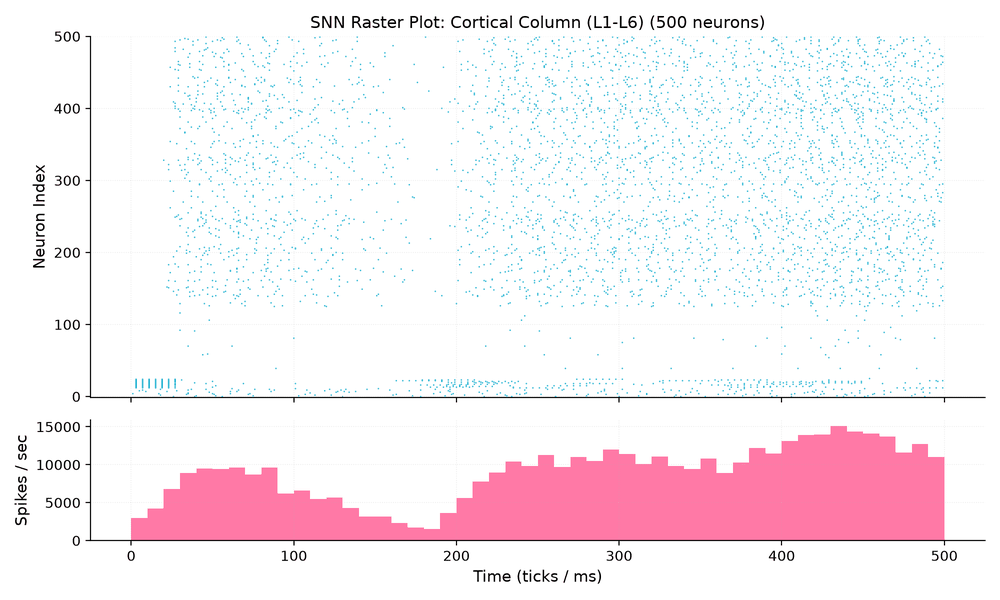
The raster written by simulate --raster (one tick = 1 ms).
2. Grow a circuit from a genome (Python)
The example below grows a sensor sheet that projects topographically onto a map, stimulates two opposite corners of the sheet and checks where the map responds.
python examples/topographic_map.py --cpu
stimulus at corner (0, 0): 4 map neurons fire, spike-weighted mean u of the map 0.09
stimulus at corner (1, 1): 7 map neurons fire, spike-weighted mean u of the map 0.74
wrote example_out/network.json and example_out/module.json
u is the position along the map’s first axis (0 to 1). In this simulation, stimulating the corner (0, 0) of the
sheet activates the near side of the map, and the opposite corner the far side. The core of the script:
import numpy as np
from neurogenesis.development import BodyPlan, FixedPlacement, Region, grow, region_of
from neurogenesis.spiking.batch import simulate_counts

side = 6
sheet = [[(i + 0.5) / side, (j + 0.5) / side, 0.5] for i in range(side) for j in range(side)]
plan = BodyPlan(name="topographic map", regions=[
    Region("sensor", origin=(0, 0, 0), size=(30, 30, 5), placement=FixedPlacement(sheet), role=1),
    Region("map", origin=(50, 0, 0), size=(30, 30, 10))],
    projections=[("sensor", "map")])

genome = dict(count=dict(map=200), inh_weight_factor=2.0, w_clip=2047,
              migration=dict(map=dict(mean=np.full(3, 0.5), spread=0.35)),
              inhibitory=dict(map=dict(a0=-6.0, a=np.zeros(3))),
              guidance={("sensor", "map"): dict(B=np.diag([2.0, 2.0, 0.0]), c=np.zeros(3),
                                                 sigma=0.12, p0=0.9, w=900.0)})

net = grow(plan, genome, seed=0)                  # deterministic for a given seed
sensor = region_of(net, plan, "sensor")
ext = np.zeros((1, net.num_neurons), np.int32)
ext[0, sensor[0]] = 120                           # constant current into one sensor neuron
counts = simulate_counts([net], [ext], ticks=50)[0]
net.save_json("network.json")
3. Look at it
cd viz && npm run dev
Open http://localhost:5173, click Import and choose example_out/network.json.
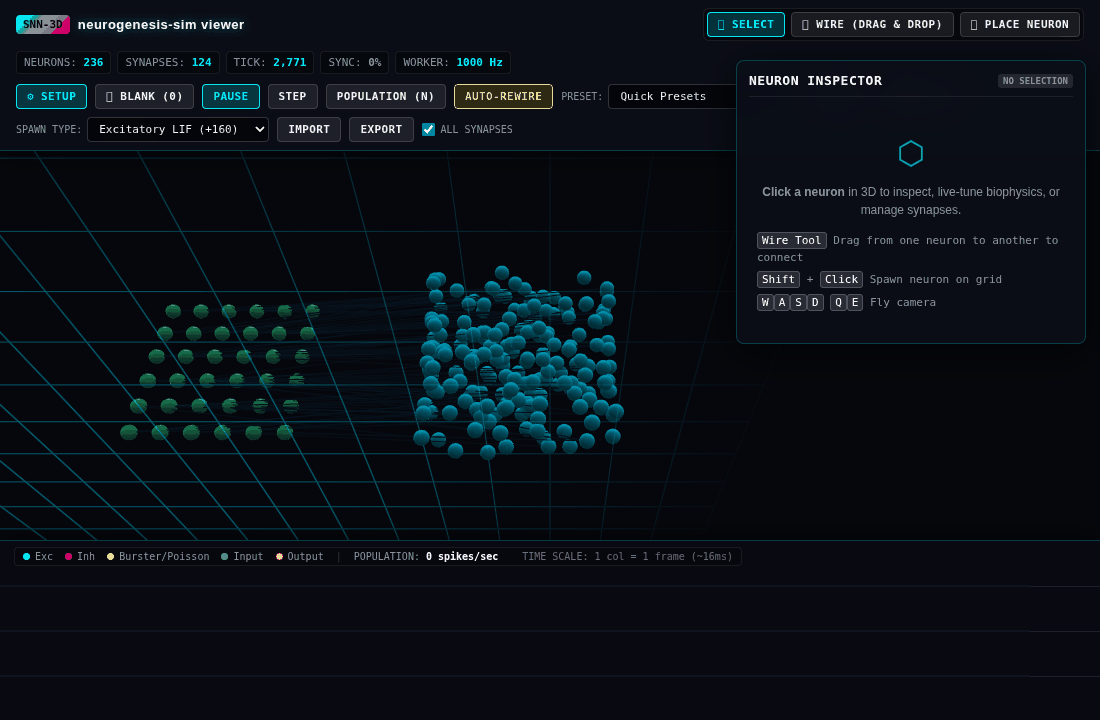
The browser viewer with an imported network.
4. Know the cost before scaling up
python -m neurogenesis estimate --neurons 1e5 --synapses-per-neuron 1000 --seconds 1
100,000 neurons, 100,000,000 synapses, 1 simulated s (1,000 ticks of 1 ms)
  lif_int          fits (memory 2.5 GB of 66.8 GB available); about 24.7 min for 1000 ticks (24.7 min per simulated second)
  two_compartment  fits (memory 2.5 GB of 66.8 GB available); about 27.5 min for 1000 ticks (27.5 min per simulated second)
  hh               fits (memory 2.5 GB of 66.8 GB available); about 24.7 min for 1000 ticks (24.7 min per simulated second)
(Output on a 64-GB CPU node; your numbers depend on your machine.)
Next steps
Core concepts — the vocabulary: plans, genomes, stages, Params, tissues, modules.
Tutorials — step-by-step tutorials.