Topographic projection grown from genes
Question. Can a projection that preserves neighbourhoods (a topographic map) be specified by a handful of guidance genes, and does it hold for every developmental seed?
Model. A fixed 6 × 6 sensor sheet projects onto a map of 200 cells whose number and positions come from the genome. Each sensor axon aims at an affine function of its own position (positional chemoaffinity; Sperry 1963) and connects to map cells near that target with a Gaussian probability.
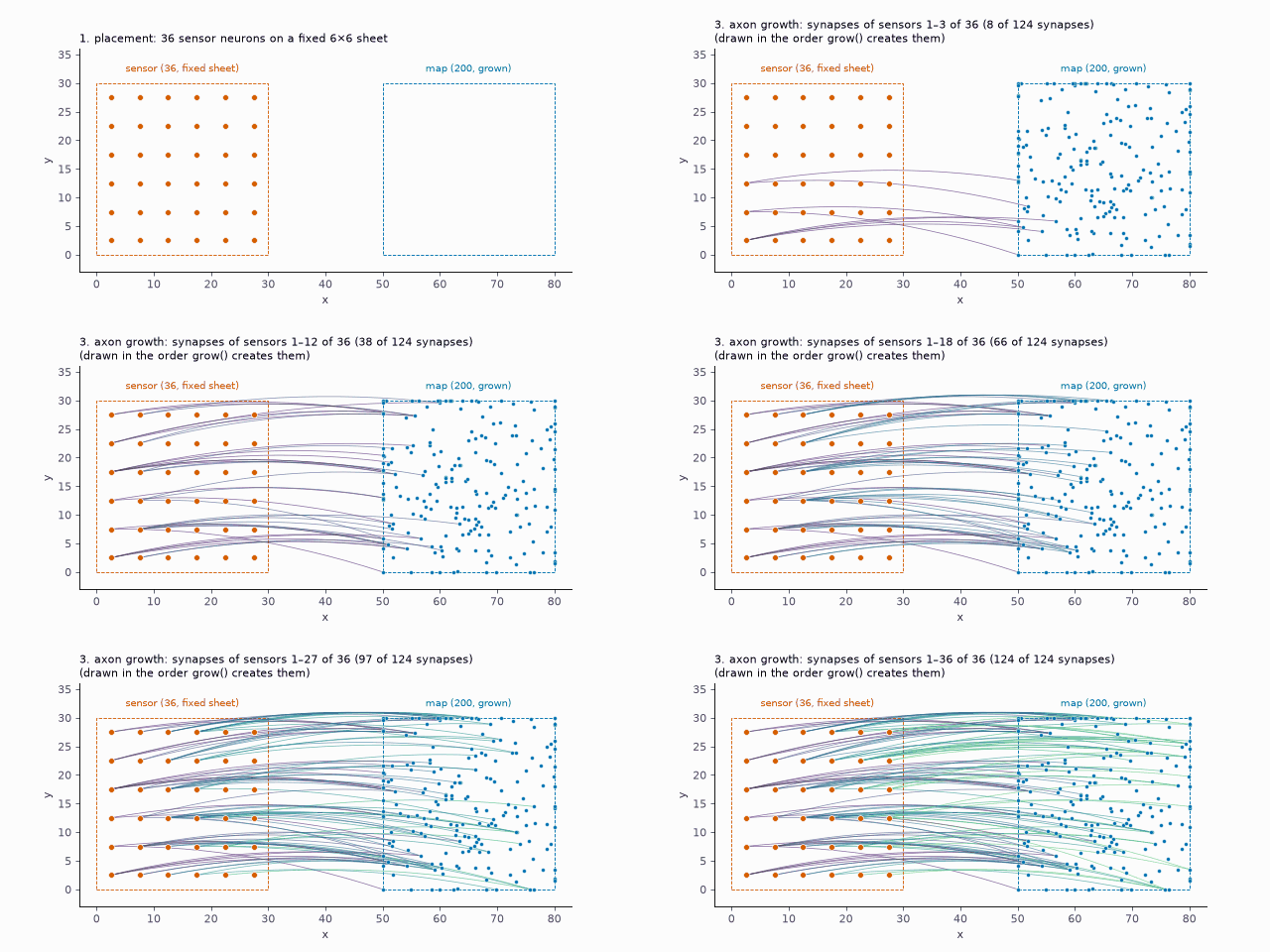
The circuit appearing step by step (see the frame titles for what each frame adds).
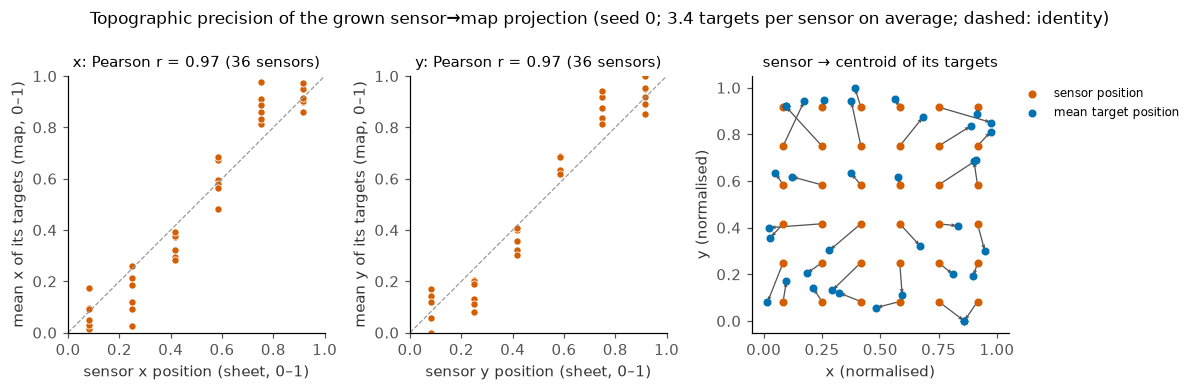
Sensor position against the mean position of its targets in the map, for the grown network.
Run it.
python examples/topographic_map.py --cpu
stimulus at corner (0, 0): 4 map neurons fire, spike-weighted mean u of the map 0.09
stimulus at corner (1, 1): 7 map neurons fire, spike-weighted mean u of the map 0.74
In this simulation, opposite corners of the sheet drive opposite sides of the map.
Going further.
Make
sigma,Bandcgenes (guidance_genes("sensor", "map")) and evolve them for topographic precision across development seeds (Tutorial 4 — Genes and evolution).Add the
topographictarget rule or a refinement stage with correlated activity (retinal-wave-like) to sharpen the map (Willshaw & von der Malsburg 1976).
PLACEHOLDER
A quantitative study: precision vs sigma and number of map cells, across 100 development seeds, with and without activity-dependent refinement.