Tutorial 4 — Genes and evolution
Genes are paths into the genome
from neurogenesis.genome import get_gene, set_gene, guidance_genes, body_genes

set_gene(genome, ("guidance", ("sensor", "map"), "sigma"), 0.2)
set_gene(genome, ("guidance", ("sensor", "map"), "B", 0, 0), 1.5)     # paths reach into arrays
print(get_gene(genome, ("count", "map")))

genes = guidance_genes("sensor", "map") + body_genes("map")          # [(path, low, high), ...]
Gene groups collect the genes of one mechanism: body_genes, guidance_genes, field_genes,
differentiation_genes, identity_genes, typed_guidance_genes. You can also write the list by hand.
[0, 1] coding and JSON
from neurogenesis.genome import to_unit, from_unit, to_json, from_json
u = to_unit(genome, genes)            # numpy vector in [0, 1]
g2 = from_unit(genome, genes, u)      # a new genome (the original is not modified); counts stay integers
d = to_json(g2)                       # JSON-ready: projection keys become "sensor->map"
Evolving one island
evaluate(genomes, seeds) returns one fitness per genome and an info dict per genome. Every generation gets fresh
development seeds, so the fitness of a genome is about all the networks it can grow, not one lucky individual.
import numpy as np
from neurogenesis.development import grow
from neurogenesis.spiking.batch import simulate_counts
from neurogenesis.evolution import evolve, choose, audit

def evaluate(genomes, seeds):
    fits, infos = [], []
    for g in genomes:
        per_seed = []
        for s in seeds:
            net = grow(plan, g, seed=s)
            counts = simulate_counts([net], [make_stimuli(net)], ticks=50, blank=40)[0]
            per_seed.append(score(counts))          # your task metric
        per_seed = np.asarray(per_seed)
        fits.append(per_seed.min() + 0.25 * per_seed.mean())   # robust: the worst seed matters most
        infos.append(dict(per_seed=per_seed.tolist()))
    return fits, infos

P, history = evolve(genome, genes, evaluate, island=0, pop=32, gens=40, seeds_per_gen=4)
best, info = choose(genome, genes, P, evaluate, seeds=(2000, 2001, 2002, 2003))   # validation seeds
Run several islands (island=0, 1, 2, ...) in parallel processes and choose among their final populations. Then
audit the chosen genome on held-out seeds never used during the search (neurogenesis.evolution.audit), including
knockouts that should break the function.
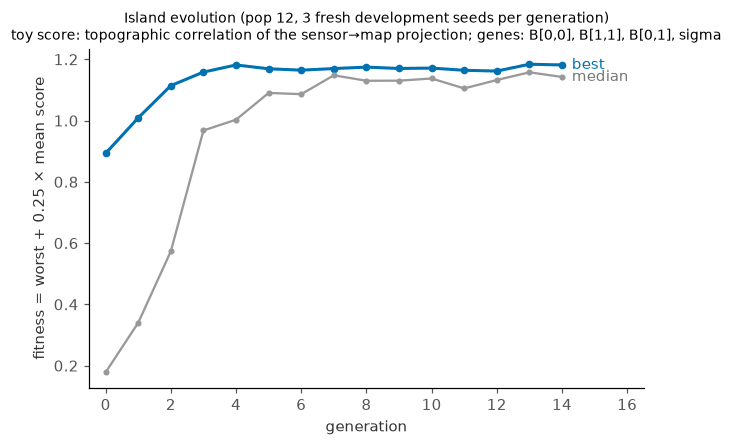
A small run of evolve on the topographic-map example: one island of 12 genomes, 3 fresh development seeds per generation, 4 guidance genes (B[0,0], B[1,1], B[0,1], sigma), toy score = topographic correlation of the projection. Best and median fitness (worst + 0.25 × mean over seeds) per generation.
Before you evolve: a capacity test
Evolution can only find what the architecture can do. First set the genome by hand (or with an oracle wiring) and check that the task is solvable. If it is not, no search will find it, and the time is better spent on the plan.
PLACEHOLDER
Tutorial on multi-island runs on a cluster (SLURM array jobs), checkpointing and resuming evolution, and a gallery of evolved modules with their audit reports.